Friday, July 3, 2015

Yankee Doodle Dandy (1942)

It's almost Independence Day here at the "screening room" (and worldwide headquarters) of At The Matinee.  While the current lineup of "summer blockbusters*" mostly consisting of "endless" reboots and remakes, there's one definitive classic that outshines the competition.  And it's perfect for the July 4th weekend.

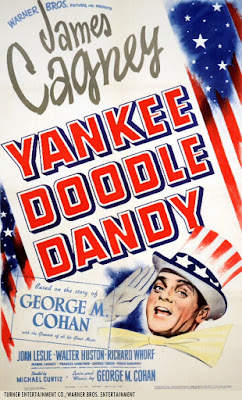
Poster for Warners' Yankee Doodle Dandy (1942)
featuring James Cagney as George M. Cohan.
That definitive classic film is 1942's Yankee Doodle Dandy.  Directed by Michael Curtiz and produced by Hal B. Wallis, the film features James Cagney (as George M. Cohan), Joan Leslie (as Mary Cohan), Walter Huston (as Jerry Cohan), Richard Whorf (as Sam Harris), Irene Manning (as Fay Tempelton), George Tobias (as Dietz), Rosemary DeCamp (as Nellie Cohan), Jeanne Cagney (as Josie Cohan), Frances Langford (as Nora Bayes), S.Z. "Cuddles" Sakall (as Schwab), and Eddie Foy, Jr. (as the senior Eddie Foy).

Based off the story of real-life songwriter George M. Cohan (1878-1942), the film goes into the life, times and career of the multi-talented entertainer and songwriter, who brought such popular classic songs including Yankee Doodle Dandy, Over There, You're A Grand Old Flag, just to name a few.

When the film premiered in New York at the Hollywood Theatre in May 1942, it was tremendous hit, and was one of the top-grossing motion pictures of 1942.  According to The New York Times, the audience on opening night purchased $5,750,000 worth of war bonds to help America's war effort during the Second World War.

For Warner Bros. (who acquired the rights from Cohan for his life story, where Warners' competitors declined Cohan's story throughout the latter years of his life), it would be the studio's top-grossing film at the time (along with Warners' other popular noteworthy films released that same year, including Casablanca, Air Force, George Washington Slept Here, and Now, Voyager).

The film won three Academy Awards for Best Actor (James Cagney), Best Sound Recording (Nathan Levinson and the Warner Bros. sound department), and Best Music, Scoring of a Motion Picture (Ray Heindorf and and Heinz Romfeld).

My first experience of watching Yankee Doodle Dandy was on WETA's Saturday classic film showcase several years ago.    I was originally going to plan to attend the recent revival screening of Yankee Doodle Dandy at the Majestic Theater in Gettysburg, Pennsylvania- but could not attend due to an important family commitment.

Warners has recently released Yankee Doodle Dandy on Blu-Ray (through the studio's "Archive" line), from a new high-definition transfer (along with several extras ported over from the previous DVD release).  It is also available for streaming on Flixster and Warners' YouTube VOD service. The film will be the highlight of Turner Classic Movies' primetime lineup for the Fourth (at 8:00 PM EST).

I'm not going to give away any other additional information on this.  To my fellow readers- if you haven't seen Yankee Doodle Dandy, see it when you have the chance to.  It is an entertaining and enlightening motion picture about the life and times of George Cohan, portrayed by James Cagney (in one of his few non-gangster roles on the screen).

I feel that in recent times, we need uplifting entertainment.  And Yankee Doodle Dandy is one of the best examples of uplifting screen entertainment.  You won't be disappointed!

1958 advertisement for Associated Artists Productions (AAP),
advertising the 1942 film Yankee Doodle Dandy, one of many pre-48
Warner Bros. feature films (along with shorts and select cartoons)
that were available for syndication to local television stations.

FOURTH OF JULY OFFERINGS ON TV:

TCM will have a schedule of movies related to America's day of independence, beginning at 11:45 AM with the 1955 film, The Scarlet Coat (featuring Cornel Wilde, Anne Francis, and George Sanders), followed by The Devil's Disciple (1959, with Burt Lancaster, Kirk Douglas and Lawrence Oliver) at 1:30 PM, the musical 1776 (1972, featuring William Daniels, Howard Da Silva and Ken Howard) at 3:00 PM, the modern comedy Miss Firecracker (1989, with Holly Hunter and Tim Robbins) at 6:00 PM, the 1943 Warner Bros. short subject on the United States Army Band at 7:50 PM, and the big highlight of the night- Yankee Doodle Dandy (1942) at 8:00 PM.  It will be followed by The Music Man (1962, featuring Preston Foster, Shirley Jones, Buddy Hackett and Ron Howard) at 10:15 PM, and Rosalie (1937, with Nelson Eddy, Eleanor Powell and Frank Morgan) at 1:00 AM (eastern standard time).

As I've stated before, it wouldn't be the Fourth of July without the annual Nathan's Famous Hot Dog Eating Contest in New York City, which will be telecast live on ESPN2 at Noon EST.  

Of course, there's always A Capitol Fourth, live from Washington, D.C. on PBS (from 8:00-9:30 PM EST).

Last but not least, it wouldn't be Saturday without Svengoolie on Me-TV, showcasing the third (and final) film in Universal's Creature From The Black Lagoon franchise, The Creature Walks Among Us (1956), which will be shown at 10:00 PM EST (for viewers from coast-to-coast, check local listings for time and channel).

WITH ALL THAT ASIDE: At The Matinee wishes everyone out there a happy (and safe) Fourth of July weekend.  Do something great and exciting during this weekend!

NOTE: Again, I'm not criticizing the recent "summer blockbusters."  I'm sure there are many (like myself) who would like more variety in the field of cinema entertainment.

Sunday, June 28, 2015

"Cool" Tivoli Theater: The tale of Frederick's first major building with air conditioning

AUTHOR'S NOTE: I have been on hiatus for a brief time, due to a recent family medical situation that took place on Father's Day (June 21st).   After several days of medical treatment and recuperation, my father is doing fine.  He is resting and relaxing comfortably at the home office and worldwide headquarters of At The Matinee.  

My family and I would like to take this time to thank everyone out there for the prayers, well wishes and kind messages of concern.   All of us highly appreciate it.  

All the best,
Chris Hamby


Marquee of The Weinberg Center For The Arts, formerly known as the Tivoli theater, which was the first major building (and cinema venue) in the Frederick area to have air conditioning.
Marquee of The Weinberg Center For The Arts, formerly known as the
Tivoli theater, which was the first major building (and cinema venue)
in the Frederick area to have air conditioning.
You may have heard by now that the Weinberg Center For The Arts (the former Tivoli theater) will be shuttering its doors for a brief period, due to the installment of a new air conditioning unit in the building, according to The News-Post.  The theater will be closed after the Frederick Film Festival concludes on June 28th, and will reopen on October 1st.  This post is being called "Cool" Tivoli, in reference to vintage newspapers calling air-conditioned cinemas "cool" in advertisements for the city's air-conditioned cinema location.

The new unit will replace the theater's older air conditioning unit, which was installed in 1940, during the "golden age" of Hollywood cinema.  To paraphrase Joe Franklin (1926-2015), let's take a trip down "Memory Lane."

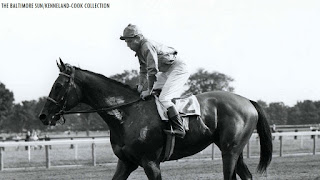
1940- Enter "Challedon," Warner Bros.' Jack L. Warner, W.L. Brann and Dr. Thomas: The idea for air-conditioning in the Tivoli theater came one day before the 1940 Hollywood Gold Cup thoroughbred horse race at Santa Anita Park in the town of Arcadia, California.

Jack L. Warner (late 1940's).
At a party that was held on the day before the race, Warner Bros. studio head Jack L. Warner was overheard by guests that he would bet $50,000 on the favorite horse in the race.  One of the guests, Dr. Edward "Eddie" Thomas, a local Frederick physician encouraged Warner to place his bet on the thoroughbred racehorse "Challedon" instead.  The youngest Warner took Thomas' advice, and decided to place his bet on Challedon.

Challedon, champion racehorse that Warner Bros. head
Jack L. Warner bet on, decided to return Dr. Edward
"Eddie" Thomas' favor on installing air-conditioning
at the studio-owned Tivoli theater in Frederick.
Thomas was close friends with advertising executive W.L. Brann (1877-1951), who bred Challedon at his own farm, Branncastle Farm (now Glade Valley Farms) in Mount Pleasant (which is close to the home office of At The Matinee).  Brann's racehorse would win both 1939 and 1940 titles of "Horse of the Year," won second place in the 1939 Kentucky Derby and won first in the Preakness stakes that same year.

Challedon won the Hollywood Gold Cup race, and Warner won his bet.  The prolific studio mogul wanted to throw a party in honor of Dr. Thomas, yet Thomas declined Jack Warner's offer.  Warner wanted to ask the Frederick physician what he could do to return the favor.  Thomas told Warner about one of his studio's theaters in Frederick- the Tivoli, and how the theater could benefit from having an air-conditioning unit in the theater.  Warner agreed, and ordered his associates in New York to install air conditioning at the studio-owned Tivoli theater in Frederick.

NOTE: Warner Bros. acquired the Tivoli, along with two other Frederick area cinema venues- the City Opera House (now Brewer's Alley Restaurant), and the Frederick theater in 1928, as part of the studio's acquisition of The Stanley Company of America, a major cinema chain (and around the same time, First National Pictures and its major Burbank studio complex, which would become the official home of Warners).

One factor of this was because of the Stanley chain's installation of Warners' landmark "Vitaphone" sound-on-disc sound motion picture projection equipment.   The studio would own these theaters until the 1948 Paramount anti-trust consent decree, where the major studios were forbidden to own movie theaters (Warners' theater holdings were spun off to Fabian Interests, and were renamed Stanley-Warner Theaters, the organization sold the three theaters to the Weinberg family at the end of the 1950's).

Since then, audiences flocked to the Tivoli to see landmark motion pictures throughout the years in the "cool" on hot summer days, along with the latest newsreels and short subjects.

An interesting tale of how a prominent Hollywood studio mogul, two Frederick residents and a celebrated racehorse brought air-conditioning to Frederick's "crown jewel" theater.

SIDEBAR: Here's something I would like to know (to the current management of the Weinberg)- When is the theater going to show classic films from Hollywood's golden age on the big screen to compliment the "Flying Dog Brewery Movie Series"?

I'm not saying that there's anything wrong with the Flying Dog Movie Series, I think it would be great (along with fellow classic cinema enthusiasts) to showcase vintage and contemporary films the way they were meant to be seen, on the big screen.   

Thursday, June 18, 2015

"Lost" reel of Laurel & Hardy's "Battle of the Century" Found


Section from a 1927-28 trade ad for Hal Roach's short subjects
(distributed at the time by MGM), featuring Laurel & Hardy.
A missing link to one of the most iconic moments in cinema history has been found, after one of the reels for this classic 1927 slapstick short was considered "lost" for many years.

According to Matthew Dessem's article on Slate, the discovery was recently announced at the Library of Congress' fourth annual Mostly Lost classic film festival.

The festival showcases select restored motion pictures that were once considered to be lost (or surviving fragments from "lost" motion pictures) at the State Theater in Culpeper, Virginia, the same city that is home to the Library of Congress' National Audio-Visual Conservation Center.

Dessem's article mentioned that silent film historian Jon Mirsalis uncovered the "lost" second reel of the classic 1927 Hal Roach comedy, Battle of the Century (featuring Stan Laurel & Oliver Hardy).  The second reel of the comic duo's 1927 short was classified as "lost" for nearly 60 years, due to the fact that clips from the film were used for a compilation film on classic moments in motion picture comedy (the "pie fight" sequence was served as the inspiration for Blake Edwards' 1965 farce, The Great Race).

ENTER ROBERT YOUNGSON: In 1957, filmmaker Robert Youngson (1917-1974) decided to make a feature-length motion picture, a compilation celebrating classic silent comedy, utilized from the libraries of Mack Sennett and Hal Roach.  This compilation film was titled The Golden Age of Comedy.

SIDENOTE: Youngson was no stranger to the industry, he originally made retrospective short subjects for Warner Bros., beginning in the late 1940's (compliled not only from the studio's own films, but from Warners' Vitagraph and First National holdings).  Some of Youngson's short subjects for Warners can be seen from time to time on Turner Classic Movies.

Fast forward to 1957, and Youngson was making his feature-length tribute to classic silent comedies. According to further findings from Dessem, Youngson might have been one of the last persons to see Battle of the Century in its complete form at the time.  He chose the legendary "pie fight" sequence in Roach's film, and it is widely speculated that Youngson junked the rest of Battle of the Century.

Shortly after the release of Youngson's compilation film, the original nitrate camera negatives became unusable (either due to mishandling or poor film storage).

It wasn't until last year, when Mirsalis found a can (acquired as part of a private film collection that once belonged to the late Gordon Berkow) with a label identifying the second reel of Battle of the Century. Thought to be lost, the film elements for Hal Roach's Battle of the Century are now being restored by Lobster Films in Paris.

This might be a clear sign that there will be a "complete" version of this classic Laurel & Hardy film sometime in the near future.

Friday, June 12, 2015

ATM Remembers: Sir Christopher Lee (1922-2015)

1972 promotional ad for Warner Bros.' "Horroritual,"
encouraging exhibitors to induct audiences
into the "Count Dracula Society," during
midnight screenings of Hammer's Dracula A.D. 1972,
featuring Christopher Lee (in his sixth portrayal
of Bram Stoker's vampire character).  This was
advertised as a "double feature" with another
Hammer horror feature released by Warners,
Crescendo (featuring Stefanie Powers).
Christopher Lee, in a publicity photo for his
role of Count Dracula in Dracula A.D. 1972.
At The Matinee remembers distinguished actor Sir Christopher Lee, who died at the age of 93 on Sunday in London.  Lee's death was not made public until Thursday.

The actor appeared in over 250 feature films throughout his career, mostly known for his villainous roles in cult British horror films produced by the Hammer Film Corporation, and for his role as the wizard Saruman in Peter Jackson's adaptations of J.R.R. Tolkien's The Lord of the Rings and The Hobbit trilogy film series.

Lee was born on May 27th, 1922 in London.  After serving as an intelligence officer for the Royal Air Force during the second World War, Lee's cousin suggested that he consider acting.  Shortly thereafter, he signed a contract with the Rank Organization, one of  the leading motion picture production and releasing companies in Britain at the time.  This led Lee to minor roles early in his screen career, beginning in 1948 with Corridor of Mirrors, and the filmed adaptation of Shakespeare's Hamlet, featuring Lawrence Oliver, which was released that same year.

Because of his tall height (6-foot-4), it has been noted that Lee was typecast throughout most of his motion picture career in villainous roles, especially in horror and fantasy films.  Beginning in 1957, his first major role for Hammer Films (in conjunction with Warner Bros.) was his portrayal of Mary Shelley's Frankenstein, in The Curse of Frankenstein, opposite Peter Cushing.  The film opened to mixed reviews in the United States, but is now considered a "cult classic" by many in recent years.

One year later, Lee would portray one of his most famous roles in another Hammer horror adaptation of Bram Stoker's Dracula, in Horror of Dracula (which was known as Dracula in Britain, but was re-titled for the American market, so that audiences would not confuse the film with the 1931 Bela Lugosi version).

Lee's "Dracula" role would lead to several more films: Dracula: Prince of Darkness (1966), Dracula Has Risen From The Grave (1968), Count Dracula . Taste The Blood of Dracula, Scars of Dracula (all from 1970), Dracula A.D. 1972 (1972) and The Satanic Rites of Dracula (1973). 

He also portrayed the mummy Kharis in Hammer's 1959 adaptation of The Mummy.  Lee also portrayed Sherlock Holmes in the 1962 German film, Sherlock Holmes And The Deadly Necklace (which was not released in the United States until 1968, when Columbia Pictures acquired the North American television rights for its Screen Gems subsidiary).

Lee would also portray Sax Rohmer's Fu Manchu character, beginning in 1965 with The Face of Fu Manchu.  He would act in four more films in this series, ending with The Castle of Fu Manchu (1969, which was famously mocked on Mystery Science Theater 3000 in 1992).

Lee's other prolific roles included Lord Summerisle in the 1973 horror film, The Wicker Man, and in the James Bond film franchise, playing villain Scaramanga in The Man With The Golden Gun (1974, opposite Roger Moore as James Bond).

Around the same time  his role in The Lord of the Rings trilogy, Lee played the role of villain Count Dooku in George Lucas' Star Wars Episode II: Attack of the Clones (2002), and Star Wars Episode III: Revenge of the Sith (2005).

In 2009, Lee was knighted by Prince Charles, in honor of his acting and charitable work. In 2010, Sir Christopher Lee crossed into the field of recorded concept music, by releasing a heavy metal-classical concept album, titled Charlemange: By The Sword and the Cross.  That same year, he received the "Spirit of Metal" award at the Metal Hammer Golden Gods award ceremony.   Four more concept albums would follow, along with four heavy metal Christmas singles.

In remembrance of Lee, Turner Classic Movies will present a marathon of Sir Christopher Lee's best-known motion pictures on June 22nd.  Here are the films that will be shown on that day's schedule:

6:15 AM- The Mummy (1959)
8:00 AM- The Curse of Frankenstein (1957)
9:30 AM- Horror of Dracula (1958)
11:00 AM- Dracula, Prince of Darkness (1966)
12:45 PM- Dracula Has Risen From the Grave (1969)
2:30 PM- Horror Express (1972)
4:00 PM- The Three Musketeers (1972)
6:00 PM- The Four Musketeers (1975)

Farewell to one of the greats of the silver screen, Sir Christopher Lee (1922-2015).

Wednesday, June 10, 2015

Newsreel Corner: Cross-Promotion for Vinnie Bell and the Coral "Electric Sitar"

Cross-promotion was nothing new for the major studios and their motion picture newsreels.  Up until the time of television (and before the 1948 "Paramount" anti-trust consent decree), the major studios usually had their newsreel units cover Hollywood or New York premieres of their parent studio's motion pictures, or in the form of one-reel publicity short subjects.

For the newsreel that was recently unearthed on the official YouTube channel of the National Archives and Records Administration, it not only shows one recording artist and his rendition of a popular song, but also showcasing a unique "electric" version of the sitar instrument.

The interesting fact is that the artist's recording label, the company that manufactured the instrument, that the artist is using during the recording session and the studio that filmed the newsreel have some sort of connection to each other.  And that ties in with the category of "cross-promotion."

Vinnie Bell, then a Decca recording artist, showcases his Coral Electric
Sitar, in a piece for the September 9th, 1967 edition of the
Universal Newsreel.  Eventually, this was a cross-promotion piece
for parent company MCA, and its divisions (Universal,
Decca,and Coral/Danelectro).  
1967: By this time, the motion picture newsreel was winding down in production, and there were only two newsreels in circulation: Universal Studios' Universal Newsreel and Hearst's News of the Day (formerly known as Hearst Metrotone News, as it was released by Metro-Goldwyn-Mayer).

In the edition of Universal's newsreel (narrated by Ed Herlihy) that was released on September 9th, 1967, the story was on Decca recording artist Vincent "Vinnie" Bell, showcasing and playing his new Coral "electric sitar" instrument.  The song that Bell played during the newsreel was a rendition of the Bert Kaempfert song, "That Happy Feeling."

Ironically, Decca handled North American licensing rights and distribution of the original German Kaempfert recording in 1962.

WHAT DOES THIS HAVE TO DO WITH CROSS-PROMOTION? In 1962, the Music Corporation of America (MCA), the leading talent agency and television syndication/production company (headed by Lew Wasserman), acquired American Decca Records.  Along with Decca and its subsidiary labels, MCA also acquired Universal Pictures as part of the package (four years earlier, the company acquired the Universal Studios lot in Universal City, California- primarily for production of the company's television shows).

This did not sit well with the Justice Department, so to avoid any anti-trust concerns, MCA divested its talent business, and decided to focus on motion pictures, television production/syndication and recorded music.

In 1966, the company decided to expand into the field of musical instruments, by acquiring the Danelectro Corporation, which was founded in 1947 by Nathan I. "Nat" Daniel (1912-1994).

Danelectro was known for manufacturing electric guitars not only under their own name, but for catalog department stores including Sears, Roebuck & Company (under the "Silvertone" brand) and Montgomery Ward (under the "Airline" brand).

According to the May 1967 press release in Billboard, the MCA subsidiary introduced the first electric sitar on the market, along with the research and development of both Vinnie Bell and and Nat Daniel.  The instrument was introduced to the public at the Chicago Music Show that same year.

When this instrument was put into production, the electric sitar did not bear the "Danelectro" name.  It was made under the "Coral" name, as Coral was a former sister label to Decca, only re-purposed by MCA for the production of musical instruments during this time, to compliment the entertainment conglomerate's music and home entertainment subsidiaries (including a line of "Decca Musical Instruments").

Yet, the relationship between MCA and Nat Daniel would not last long, as the entertainment conglomerate shuttered the musical instrument division, due in part to lackluster sales.

WITH ALL THAT ASIDE:  Not only is this an interesting look at cross-promotion, but this is a unique look at Bell and his "electric sitar."

At the end of 1967, Universal Studios decided to end their newsreel operation, while competitor Hearst decided to focus on the existing Screen News Digest newsreel series for classroom presentation (more on Hearst and SND can be found here).

Now presented from a new high-definition transfer from the National Archives and Records Administration (with other select Universal Newsreels on their YouTube channel), one can finally see the clarity of Vincent Bell, hard at work with Decca recording engineers recording his rendition of "That Happy Feeling,"

An interesting piece of cross-promotion between Universal's parent firm (MCA), showcasing their recording artist (on Decca) with the latest innovation in the field of  electric musical instruments (the Coral Electric Sitar) at the time.

"DOWNTOWN MOVIE NIGHT ON THE CREEK" IS BACK: One year ago, At The Matinee reported on the Downtown Frederick Partnership and their Free Movie Night on the Creek series.

The organization is bringing the event back for this year, by kicking off the series and showcasing Steven Spielberg's 1993 masterpiece, Jurassic Park (based off of the novel by Michael Crichton).

The outdoor showing of Jurassic Park will be shown at the Carroll Creek Linear Park on the evening of July 24th.  Doors open at 7:00 PM, and the film begins at 9:00 PM.  This is being shown in relation to the new installment in Universal's franchise, Jurassic World (which will be released in theaters nationwide on June 12th).

Last year, I asked one of the directors of the Downtown Frederick Partnership if the event would include revival screenings of classic and contemporary films.  Though I did receive a prompt response from the executive director of the organization last year- the group did not have any plans of showcasing classic or contemporary feature films during the event.   Yet another unfortunate indicator of classic cinema being ignored in the Frederick area.

To all fellow readers of At The Matinee:  When I learned that the Downtown Frederick Partnership was bringing back its Free Movie Night on the Creek festival, I left a message on the organization's Facebook page.

If you're interested in requesting that classic films be shown during the event, let your voice be heard- by posting on the Downtown Frederick Partnership Facebook page, or by directly contacting the group here.

NOTE: I'm not badmouthing the current lineup of motion pictures for the festival, just suggesting that classic and contemporary films on a giant outdoor screen would be great for those that may have never seen them on the big screen before.

Previous posts on Free Movie Night on the Creek can be found here and here.

Saturday, May 30, 2015

One Last Look: Walkersville's T.R. Saylor & Company Hardware Store (1903-2015)

NOTICE: All Rights Reserved by Chris Hamby Films/Chris Hamby Enterprises.
T.R. Saylor & Co. (True Value) Hardware, January 2015
(featured in Hood College's "Home" photograph
exhibition in February 2015).
NOTICE: All Rights Reserved by Chris Hamby Films/Chris Hamby Enterprises.
END OF AN ERA: T.R. Saylor & Co.,
"Going Out of Business" (May 29, 2015).
"It ain't just paint."  -Tagline for Martin Paint, a New York-based hardware and paint retailer, which was in business from 1942 to 1996.  Martin Paint was one of the longtime sponsors of The Joe Franklin Show.

END OF AN ERA: At The Matinee shifts gears from the field of classic, cult and contemporary cinema to the local hardware store.  In these times (especially in Frederick County, Maryland)- local hardware stores are virtually obsolete, thanks to the monstrosity of boring "big box" hardware retailers in the Frederick area.

Unfortunately, this year marks the end of an era for a local hardware retailer in the same hometown where my classic film blog originates from.

T.R. Saylor & Company, which has been part of the Walkersville community for over 112 years, is closing its doors for good.  The business was established by Thomas Ralph "T.R." Saylor in 1903.

Throughout the years, not only did it operate as a hardware and paint store- it also operated as a service station, with their noticeable vintage Shell gas pump(which was still on display outside long after the store discontinued selling gasoline, the store's owners removed the vintage gas pump several years ago).  The store was affiliated with American Hardware Supply, which later became ServiStar, which merged with the parent company of True Value Hardware in 1997, making T.R. Saylor & Company part of the True Value network of local and regional hardware retailers.

As one walked into T.R. Saylor & Company, it was much more than a local hardware store. Customers received friendly and knowledgeable service- which is a rarity these days.

SIGN OF THE TIMES: Vintage General Electric (GE)
lighting display rack inside T.R. Saylor & Co.
Not only did Walkersville's local hardware store carry the latest in hardware and garden equipment, they also carried rare items that have been on the shelf for years- including a vintage GE "hot lather" shaving cream dispenser, a Black & Decker electric shoe polisher, along with bulk mint-condition Memorex blank VHS tapes (dating back to the late 1980s, still in its original shrink wrap).  Some items still had vintage "American Hardware" or "Servistar" price stickers.

I first heard about the closing when I received a letter in the mail from the store earlier this months (on the day of final exam for my "Screen Craft" class at Hood), announcing that the store would close for good.   One of several factors was that the current owners wanted to retire, another was the opening of Lowe's at the "Clemson Corner" shopping center in 2011.  In this writer's view, Frederick did not need another grungy, boring and depressing "Lowe's" location (along with the sprawl on Route 26).

Earlier this year, I photographed the storefront of T.R. Saylor & Company, for my Hood College photojournalism class project, in relation to the theme of "home."  My picture was featured in the Hood "home" exhibition, and received positive praise from fellow friends, students, instructors, spectators and art lovers.  I was hoping that my picture in the  exhibition would help bring in more business for the store.

Even though T.R. Saylor & Co. will be no more, the name will be with the now-defunct local hardware stores of the region- including Ingalls Lumber of Middletown (which was associated with American Hardware/Servistar and True Value until its demise) , and May's Hardware in Frederick.

With the demise of T.R. Saylor & Co., Woodsboro's N.Z. Cramer & Son is one of the last locally-owned hardware and lumber retailers in the region.

Farewell to T.R. Saylor & Co.  It won't be the same without a "real" hardware store in the area.

Monday, May 25, 2015

Memorial Day

1942 advertisement for Paramount Pictures. and the studio's newsreel coverage
of War in the Pacific, filmed by staff news cinematographer Arthur "Art" Menken.